




Automated Storage Systems in Warehouses
Maximize warehouse capacity, accelerate material flows and maintain complete inventory control with scalable AS/RS solutions.
Automated Storage Systems in Warehouses
Maximize warehouse capacity, accelerate material flows and maintain complete inventory control with scalable AS/RS solutions.
Automated Storage & Retrieval Systems (AS/RS)
Maximize warehouse space. Boost picking efficiency. Automate with confidence.
Alstef Group designs and integrates automated storage solutions for pallets and heavy loads.
Designed for warehouses and manufacturing facilities, our Automated Storage and Retrieval Systems (AS/RS) optimize storage capacity, material flows and space utilization.
Make the most of your available warehouse space with high-density storage solutions.
Accelerate storage and retrieval operations to support higher production and distribution volumes.
Maintain real-time stock visibility and reduce inventory discrepancies.
Adapt your storage system as your business grows without disrupting operations.

Warehouse storage applications
Designed for a wide range of warehouse and manufacturing environments, our automated storage solutions can support every stage of your internal logistics flows, from raw material reception to finished goods dispatch.
Typical applications include:
- Raw material storage
- Finished goods warehouses
- Production buffer storage
- Cold storage environments
- Order fulfilment operations
Automated pallet and heavy loads storage
Alstef Group designs and delivers turnkey automated warehouses tailored to your operational needs. By integrating your logistics flows, operational constraints and warehouse data, we create intelligent storage solutions that optimise performance today while remaining flexible for tomorrow.
Our portfolio includes a wide range of high-bay storage technologies, allowing us to design the automated storage solution best suited to your requirements:
Stacker cranes
Designed for high-bay warehouses, stacker cranes provide fast, reliable and high-density pallet storage. They maximize the use of vertical space while ensuring precise, automated storage and retrieval for high-capacity operations.
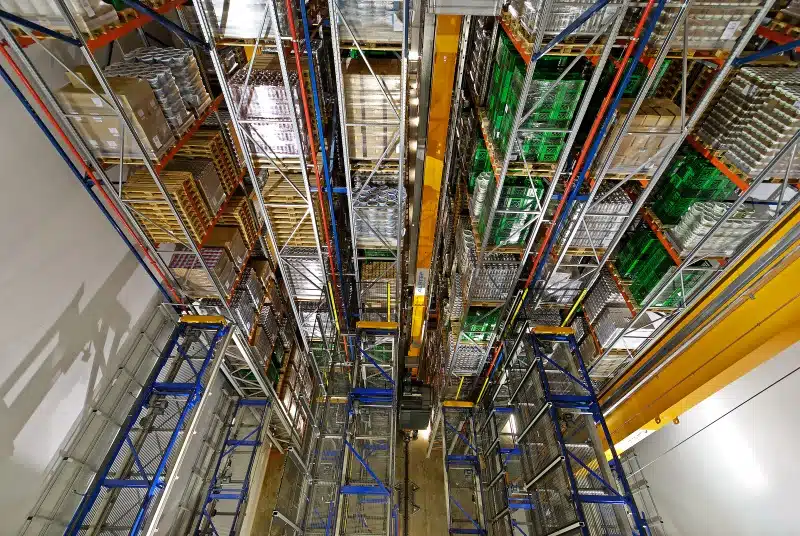
Storage shuttles
Shuttle systems deliver high throughput and flexibility for automated pallet storage. By operating simultaneously on multiple levels, they optimize storage density while supporting demanding production and distribution environments.
AGVs
Automated Reach trucks and VNA Guided Vehicles transport, store and retrieve pallets autonomously, making them ideal for dynamic storage areas and operations requiring high flexibility.

Proxyshuttle
Designed by Alstef Group, Proxyshuttle is a compact buffer storage solution managing pallet sequencing and temporary storage before order picking, shipping or production supply.

Storage of bins or boxes
Alstef Group offers integrated systems, fully adapted and scalable, for the storage of bins and boxes.
Single or multiple depth stacker cranes, or shuttle systems can optimize your order preparation.
Alstef Group offers tailored integration ensuring all upstream and downstream operations as a complete turnkey solution.
The bin and cardboard storage solutions will often be integrated into a global solution including pallet storage and all the associated transitics.

Our storage automation projects


From Storage to Complete Warehouse Automation
Automated storage is only one part of an efficient warehouse automation system. We design fully integrated solutions that combine storage, transport, order picking, mobile robotics and warehouse software to optimize every stage of your internal logistics.
FAQ - Automated Storage Warehouse
The right solution depends on several factors, including required storage capacity, inbound and outbound throughput, the number of SKUs and pallets per SKU, available floor space and height, load characteristics, and building constraints. Depending on these requirements, the system may use stacker cranes, pallet shuttles, VNA or Reach Truck AGVs, or a combination of several technologies.
The main solutions include stacker cranes, particularly suited to high-bay storage and high throughput; pallet shuttle systems, designed for high-density, deep-lane storage; and storage AGVs, which automate pallet storage and retrieval within racking systems. Each technology can be configured according to the specific requirements of the project.
Automation can make better use of both available floor space and building height. Depending on the facility, this may involve very narrow aisles with VNA AGVs, deep-lane storage with pallet shuttles, or high-bay storage with stacker cranes. The objective is to increase the number of pallet locations while maintaining the required system performance.
A storage automation project starts with an analysis of operational flows and requirements: storage volumes, inbound and outbound throughput, SKU profile, pallet characteristics, available space and operating constraints. This information is used to size the system, define its interfaces with other warehouse flows and determine the most appropriate storage architecture. Automation should therefore be considered as a complete system, from pallet movements to inventory and equipment control.
Yes. Automated storage can be integrated into an existing building, but the most suitable technology will depend on its constraints, including height, available space, structure, existing racking and the extent of possible modifications. AGVs can help minimise fixed infrastructure requirements, while shuttle or stacker crane systems may also be suitable where the building configuration allows.
Yes, although the level of scalability depends on the technology and system architecture. An AGV or shuttle fleet, for example, can be expanded by adding vehicles as throughput requirements increase. For systems that rely more heavily on fixed infrastructure, anticipating future requirements during the design phase is essential to allow for future capacity or system extensions.